The Valley of the Moon in San Pedro de Atacama (northern Chile) is one of those places that changes its appearance as the light shifts. Ochre, gray, and white tones and soft violet hues overlap in a landscape formed by layers of salt, clay, and ancient sediments. It's neither an optical illusion nor a photographic trick: it's a real phenomenon that makes this corner of the Atacama Desert one of the most striking landscapes in South America.
What is the Valley of the Moon and why does it look like it's from another planet?
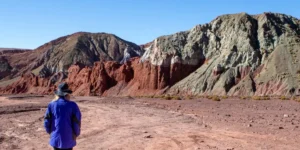
He Valley of the Moon It's one of those places that needs no explanation when you're standing before it. The terrain is harsh, almost devoid of visible life, with sharp ridges, fine sand dunes, and rock formations that seem purposefully sculpted. There are no trees, no rivers, no clear signs of human presence, and this makes the landscape feel strange even to those who have seen other deserts. The most common feeling is being in a place that doesn't quite fit with the Earth we know.
That “otherworldly” look is no accident. The Valley of the Moon is part of the Cordillera de la Sal, a geological formation where ancient marine sediments were trapped as the Andes rose. Over millions of years, these layers were compressed, folded, and exposed to an extremely dry climate. With no vegetation to soften the shapes and no water to round them, the terrain was left bare. Everything looks raw, exaggerated, almost unreal. That's why many people compare this valley to lunar landscapes: it shares that same sense of emptiness and timelessness.
Furthermore, silence plays a key role. Here, sound fades quickly, the wind is the only constant movement, and the landscape seems frozen in time. This combination of stark forms, mineral colors, and the absence of any apparent life is what makes the valley not only look like another planet, but feel like one.
The mineral origin of the colors of the Valley of the Moon
The colors of the Valley of the Moon are not a trick of light or a photographic effect. They are there because the soil and rocks are rich in different minerals, each reacting differently to sunlight. Ochre, reddish, gray, white, and even violet tones appear layered, telling the chemical history of the place. Each color speaks of a type of mineral, a specific geological process, and a distinct stage in the valley's past.
Salts play a fundamental role: the Cordillera de la Sal gets its name precisely from the large amounts of sodium chloride and gypsum that accumulated when this area was an inland sea. Many of the whitish and light gray surfaces you see today are remnants of that evaporation. Add to that clays, sulfates, and other compounds that, after being exposed for millions of years, dehydrate and subtly change color. The result is a soft, mineral, natural palette that varies with the orientation of the terrain and the time of day.
What's interesting is that these colors aren't "painted" uniformly. The valley displays veins, bands, and irregular patches because the minerals weren't all deposited at the same time or under the same conditions. It's a chemical landscape, where each hue is a clue to the type of environment that existed when that layer formed.
How extreme erosion shapes the landscape
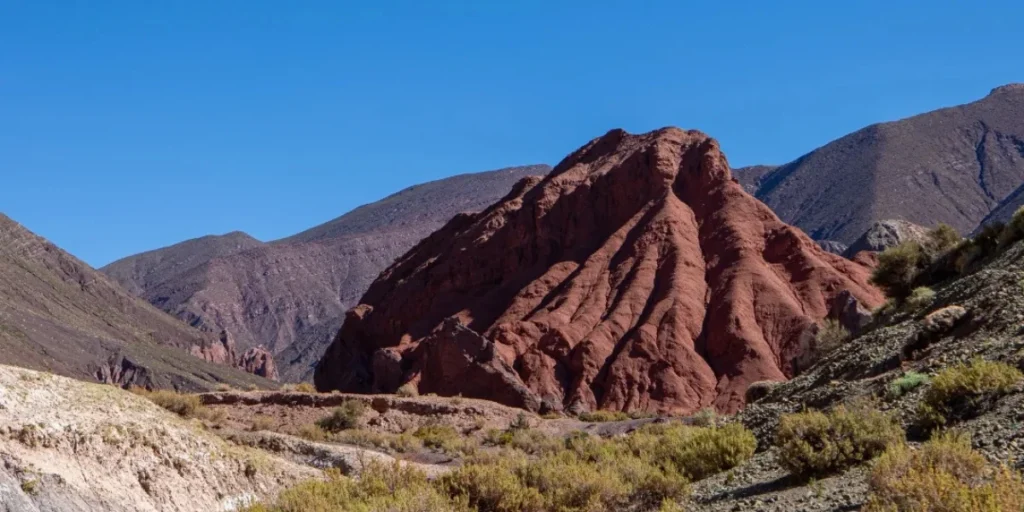
In the Valley of the Moon, erosion doesn't act quickly, but it works tirelessly. The almost complete absence of rain means that water doesn't round or soften the shapes. Instead, the wind becomes the great sculptor of the landscape. For thousands and millions of years, fine particles of sand have been pounding the rock, polishing it, cutting it, and giving it those sharp, undulating shapes that seem almost artificial.
Abrupt temperature changes also play a role. During the day, the rocks heat up intensely; at night, the cold is immediate. This constant expansion and contraction creates microfractures that, over time, weaken the material. The wind then removes the loose fragments, exposing new surfaces and accentuating existing shapes.
Because there is almost no vegetation to stabilize the soil, erosion acts directly on the rock. Nothing slows the process. That's why the Valley of the Moon has such a striking, almost exaggerated appearance, as if every line were underlined. It is a landscape sculpted by the patience of time and the relentless force of the extreme climate, where every shape you see is the result of a slow, continuous, and uninterrupted process.
The role of light and the sun in unreal colors
In the Valley of the Moon, light is not merely an accompaniment to the landscape; it is one of its protagonists. The Atacama Desert sun shines with an intensity and clarity that few places in the world can offer. With so little humidity and almost no airborne particles, the light arrives directly, unfiltered, striking the rocks with striking intensity. This causes the minerals to reflect their true colors, without softening or blending them, making the landscape appear more contrasted, sharper, and, for many, almost surreal.
The shape of the terrain amplifies this effect. Sharp ridges, stratified walls, and undulating surfaces receive light from different angles simultaneously. While one slope is bathed in sunlight, another remains in shadow, and this difference brings out the mineral colors with much greater intensity. It's not that new colors appear, but rather that the sun selectively "activates" them, as if the landscape were designed to respond to the light.
Furthermore, the sun's position itself changes how we perceive color. When the sun is high, the light is whiter and more uniform, and the tones appear drier and more raw. Conversely, when the sun is lower, the light becomes warmer and more grazing, and the minerals begin to reflect orange, reddish, and golden hues. The valley itself doesn't change, but the light does, and that completely transforms the scene.
Why do colors change depending on the time of day?
One of the most striking experiences for visitors to the Valley of the Moon is realizing that the landscape never looks the same twice. In the early morning, the colors tend to be cooler and softer. Shadows are longer, contrast is less pronounced, and grays, beiges, and muted tones predominate. The valley feels quieter, more contained, as if it were still awakening.
As the day progresses, the sun climbs higher and the colors become more direct and contrasting. Ochres and yellows gain prominence, white surfaces reflect more intensely, and the landscape appears visually flattened. It's a time when the landscape looks harsher, more desert-like, and when fine details can be lost in the intense light.
The big change comes at sunset. As the sun nears the horizon, the light comes in almost horizontally and sweeps across the rock layers, highlighting every texture. Golden, orange, and reddish tones appear on the salt and clay surfaces with an intensity that seems exaggerated but is completely real. That's why sunset is the most sought-after moment: not because the valley is different, but because the light reveals its full potential. It's at that moment that the Valley of the Moon stops looking like a strange landscape and starts looking like it's straight from another planet.
Sunset: the most spectacular moment in the Valley of the Moon
If there is a moment when the Valley of the Moon It reveals its full character at sunset. Not because the landscape changes, but because the light transforms it completely. As the sun begins its descent, it ceases to illuminate from above and starts traversing the terrain from the side, grazing the ridges, highlighting every fold and revealing details that go unnoticed during the day. The valley seems to gain depth, as if it were unfolding in layers.
At that moment, the colors intensify in a way that surprises even those who have seen photographs. Ochres turn to gold, grays take on violet hues, and some areas acquire reddish tones that last only minutes. It is not a long or repetitive spectacle; it is a slow process at first and a dizzying one at the end, when the sun sets and the landscape changes almost every second.
The silence is also a companion. At that hour, the wind usually dies down and the valley becomes still, as if everything were waiting for the last ray of light. It's a moment that invites you to observe without haste, to put your camera aside and simply look. That's why, for many travelers, sunset in the Valley of the Moon is not just another visit, but one of the most powerful memories of their entire trip to Atacama.
Why the Valley of the Moon is unique in the world
Chile's Valley of the Moon is unique because it brings together a combination of factors that rarely coincide in a single place. It's not just an eroded landscape, nor just a dry desert, nor just a site with mineral colors. It's the sum of its marine origin (part of the Cordillera de la Sal), extreme erosion driven by wind and wide temperature swings, and near-intact preservation thanks to the almost total absence of rain in San Pedro de Atacama. Here, geological processes are laid bare, with no vegetation to hide them and no water to soften them.
Unlike other desert landscapes around the world, the Valley of the Moon is not uniform. It constantly changes shape, texture, and color over very short distances. Dunes stand next to rocky ridges, smooth surfaces beside cracked walls, and light areas contrast with almost dark ones. This variety, concentrated in a relatively small space, is what makes the place feel so special and so difficult to compare to others.
Furthermore, there's a feeling that's hard to explain, a feeling related to time. The valley doesn't seem like an "active" landscape in the everyday sense, but rather a place where time has stretched out. Everything moves slowly, everything seems ancient, as if you were walking through a fragment of the Earth that hasn't changed in millions of years. That mixture of beauty, strangeness, and silence is what makes the Valley of the Moon not just famous, but truly unique.