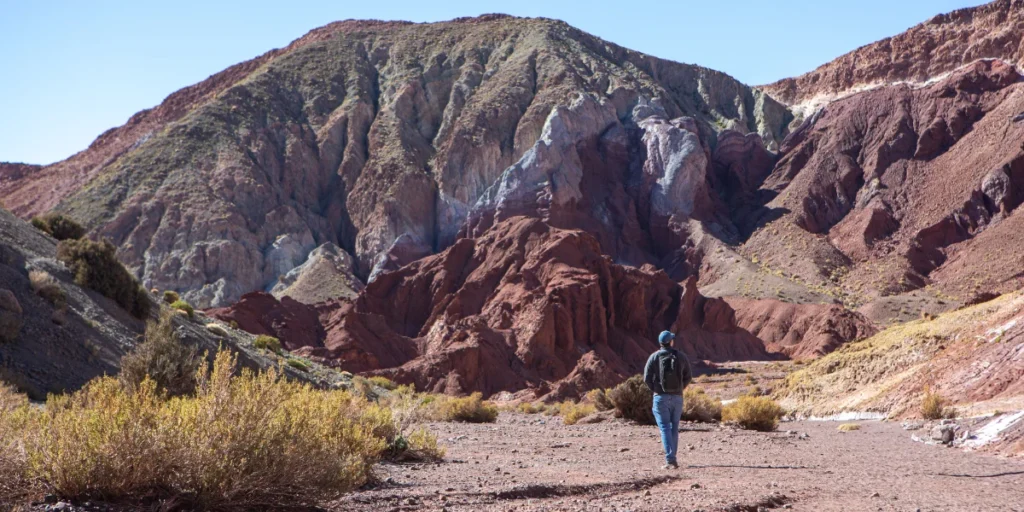
Rainbow Valley, located in the Domeyko Mountain Range 90 km from San Pedro de Atacama, is one of the most fascinating corners of the desert. Unlike other, more crowded valleys, it stands out for its diversity of mineral colors, its ancient geological formation, and a route that includes the Petroglyphs
of Yerbas Buenas, an archaeological site with rock art carved thousands of years ago. In this guide, we explain why this valley is one of the most visited by those looking to connect with the geology, history, and silence of the desert.
What is Rainbow Valley and why does it have so many colors?
The formation of Rainbow Valley dates back more than 25 million years. During that period, the area accumulated sediments of different origins, the result of ancient bodies of water, volcanic activity, and tectonic movements. Over time, these materials compacted and formed well-defined layers.
Later, the uplift of the Domeyko mountain range and erosion caused by wind and extreme temperature swings left these layers exposed. Thanks to the aridity of the desert, the geological structures have been preserved with remarkable clarity, making it possible today to observe a visible record of the region's geological history.
The Domeyko Mountain Range and its geological importance
Rainbow Valley is located within the Domeyko Mountain Range, an ancient mountain system that runs north to south, parallel to the Andes. Unlike the Andes, Domeyko is lower and less rugged, but it plays a key role in the geology of northern Chile.
This mountain range is known for its enormous mineral wealth and for having been the focus of many of the tectonic and volcanic processes that shaped the desert. The uplift of Domeyko was essential to the creation of the basins, valleys, and ravines where the sediments that now form Rainbow Valley were deposited.
Domeyko also acted as a kind of “geological archive.” As it slowly rose, it allowed the sedimentary layers to be preserved and then clearly exposed, without being completely eroded or covered by vegetation. That's why this area is so appealing to geologists and researchers: here you can easily read processes that are hidden or altered elsewhere.
For visitors, understanding the importance of the Domeyko mountain range changes the way you look at the landscape. Rainbow Valley is no longer just a colorful spot; it becomes a place where geology becomes visible, tangible, and surprisingly beautiful.
Minerals and geological layers: how the valley was formed
The story of Rainbow Valley begins more than 25 million years ago, when this area was very different from what you see today. Back then, layers of sediment rich in various minerals were deposited, the result of ancient seas, lakes, volcanic activity, and tectonic processes that shaped the land.
Each color you see corresponds to a specific mineral composition. Red hues are usually associated with oxidized iron, especially hematite. Greens and bluish tones can be linked to copper-bearing minerals. Whites come from deposits of gypsum, salt, or other sulfates, while yellows and ochers come from clays and oxides in varying concentrations. The more subtle purple tones are usually combinations of several of these minerals under certain conditions of pressure and oxidation.
Over time, the uplift of the Domeyko mountain range and intense erosion caused by wind, extreme temperature swings, and severe dryness gradually uncovered these layers. What was once buried under kilometers of sediment is now exposed like a cross-section of the region's geological past. Walking through the valley is, quite literally, walking over millions of years of Earth's history.
The Yerbas Buenas Petroglyphs: ancient rock art
Just a few kilometers from Rainbow Valley lies Yerbas Buenas, an archaeological site that preserves approximately 300 petroglyphs engraved in volcanic rock by the pre-Columbian peoples of the Andean altiplano. They are between 2,000 and 5,000 years old and depict human figures, camelids (llamas, alpacas, vicuñas, and guanacos), hunting scenes, and ritual symbols.
The site is managed by the Atacameño Community of Río Grande, which ensures its conservation and cultural respect. The visit to the petroglyphs is included in the same Rainbow Valley tour, allowing you to combine the geological wonder of the valley with the cultural and human dimension of the region in a single day.
It's one of the few places in northern Chile where you can see, in a good state of preservation, the artistic record of the desert's original inhabitants. Walking through Yerbas Buenas isn't just about looking at carved stones: it's about understanding that this desert was inhabited, traveled, and narrated for millennia before any tourist arrived.
A landscape shaped by millions of years
The landscape of Rainbow Valley is the result of slow, continuous processes that unfolded over millions of years, during which sediments of different origins accumulated: volcanic materials, clays, salts, and remnants of ancient aquatic environments. Then tectonic movements lifted the ground, fractured the layers, and left them exposed. Added to this was the relentless action of the wind, one of the great sculptors of this landscape, which gradually polished the surfaces, removed soft material, and uncovered the most resistant layers.
The desert's extreme aridity is key to this process. In other parts of the world, rain, vegetation, and chemical erosion quickly erased these formations. In San Pedro de Atacama, however, the lack of water has allowed the geological structures to be preserved for enormous periods of time. That's why Rainbow Valley feels like a natural open-air museum, where the landscape seems frozen in time.
Walking through the valley is like traversing that history without the need for maps or books. Simply observing the sloping layers, the cuts in the terrain, and the color transitions is enough to understand that here the Earth has been slowly transforming, with a patience that only geology knows.
Colors, light and the best times to visit
The appearance of Rainbow Valley changes with the daylight. In the early morning and toward the afternoon, the colors show greater contrast due to the angle of the sun, which improves the visibility of the layers and textures of the terrain.
Although it can be visited throughout the day, these times are usually the most recommended, especially for those who want to observe the landscape in greater detail or take photographs.
Rainbow Valley Wildlife: What Animals Can Be Seen
Although Rainbow Valley may seem like an almost barren environment at first glance, life is present, just in a discreet and well-adapted way. The wildlife that inhabits this area has learned to survive in conditions of extreme dryness, variable temperatures, and scarce food.
Among the most common animals you can spot are vizcachas, small Andean rodents that tend to move among the rocks, especially during the quieter hours of the day. They're quick, curious, and experts at blending into their surroundings. With a little patience, you may see them peeking out from between the stones.
You may also come across desert foxes, although they're more elusive. They tend to appear early in the morning or toward the end of the day, when there's less human activity. Seeing one crossing the valley is a clear reminder that this landscape, harsh as it may seem, is still a home.
As for birds, you can observe various species adapted to the desert and the Domeyko mountain range, such as small birds that make the most of the area's scarce resources. It's not a place with large concentrations of wildlife, but that's precisely what makes each sighting feel special.
The key to seeing animals in Rainbow Valley is silence and observation. There's no need to actively look for them or chase them. Just walk slowly, speak softly, and look carefully. The valley reveals itself little by little, and when it does, the experience becomes even richer and more authentic.
Climate and environmental conditions
The climate in Rainbow Valley is typical of the desert, but with characteristics specific to its location in the Domeyko mountain range. It's a dry environment with very little humidity, clear skies most of the year, and noticeable temperature swings, though without reaching the extreme conditions of the higher altiplano.
During the day, temperatures are usually pleasant, especially when the sun is out. However, the dry air causes the body to lose moisture without you noticing, so it's easy to become dehydrated if you don't drink water regularly. Add to that the intense solar radiation, which is felt even when the weather seems mild. Sunscreen, sunglasses, and a hat are essential here.
The wind is usually moderate, but it can pick up occasionally, stirring up fine dust from the ground. It's not a constant wind like in higher areas, but it's enough to cool the air and lower the perceived temperature, especially if you're standing still admiring the scenery. That's why carrying a light jacket is always a good idea.
Overall, Rainbow Valley is a comfortable place to explore if you're prepared. It doesn't demand the same physical effort as other high-altitude tours, but it's still pure desert, and that means respecting the climate, the sun, and the dryness of the environment.
What is the route of the Rainbow Valley tour like?
He Tour to Rainbow Valley is a half-day excursion that departs from your lodging in San Pedro de Atacama and heads west into the Domeyko Mountain Range. The full tour lasts between 4 and 5 hours, including transfers, walks, and stops at the main sites.
Along the way, the landscape changes gradually: the wide-open plains are left behind and hills, ravines, and rock formations appear in increasingly varied hues. It's common to spot vicuñas and guanacos in their natural habitat before reaching the valley.
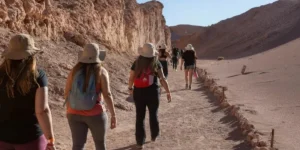
Once there, the tour is mainly on foot, along short, easy trails. The guide explains the geological context, the minerals that produce the colors, and the history of the area. The tour also includes a visit to the Yerbas Buenas Petroglyphs, where the natural landscape connects with the region's cultural heritage. The AM tour includes breakfast, and the PM tour includes snacks.
Since it's a private tour, the pace adapts to your group: there's time to take photos, observe geological details, and connect with the silence of the desert without rushing.
What to wear to visit Rainbow Valley
Although Rainbow Valley doesn't have the extreme altitude of other altiplano tours, it's still pure desert, and dressing well makes a big difference. The key is to be comfortable, protected from the sun, and prepared for slight changes in temperature throughout the tour.
It's best to wear lightweight but long-sleeved clothing, especially on top. This helps protect your skin from the sun without overheating and prevents an excessively dry feeling. Comfortable pants, ideally hiking pants or similar, work much better than shorts or jeans, as they protect you from the sun, dust, and possible scrapes against the terrain.
As for footwear, it's essential to wear closed-toe sneakers or shoes with good soles. Although the walks are short and easy, the ground is uneven and rocky in some areas. Sandals or open-toe shoes aren't a good choice here. Sunglasses, a hat, and sunscreen are a must. The radiation in San Pedro de Atacama is strong even when the temperature is pleasant. It's also a good idea to bring a light jacket or windbreaker, as the wind can pick up and cool things down, especially if you're standing still observing or taking photos.
Finally, bring water. Although the tour isn't physically demanding, the dry air can dehydrate you without you even noticing. With just the right amount of gear and a little planning, you can enjoy the tour comfortably.
Is the Rainbow Valley tour worth it?
The Rainbow Valley tour is a great option for those looking for a different kind of outing, and it stands out for its geological value, its tranquility, and the chance to observe a largely untouched landscape. It's especially recommended for people interested in geology, photography, or easy hikes, as well as for those who prefer less crowded tours with more informative content.