At nightfall, San Pedro de Atacama changes completely. The desert light fades, the temperature drops and your gaze inevitably drifts upward. You're in one of the places with the best skies on the planet, and experiencing it on an astronomy tour is, for many travelers, the most memorable moment of the trip.
In this guide, we explain how an astronomy tour in San Pedro de Atacama works, what you can observe during the night and what sets a memorable experience apart from a disappointing one. If you're planning your visit, we'll also tell you how we run The Roofless, our private astronomy tour, so you have all the information before you decide.
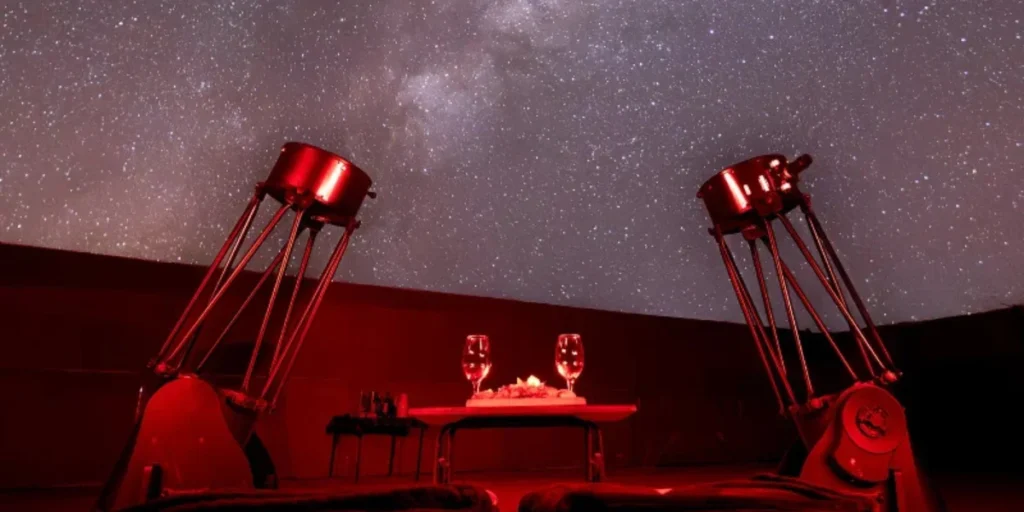
The Roofless is designed for those who prefer a night without crowds: small groups, professional telescopes, accredited guides and a souvenir photo session. But before getting into the details, it's worth understanding what makes the Atacama sky so special.
Why Does the Atacama Desert Have One of the Best Skies in the World?
The Atacama sky is renowned worldwide for offering exceptional conditions for astronomical observation, something you can clearly sense as soon as night falls.
One of the most obvious factors is how dry the air is. With so little humidity, the sky looks clearer and the stars stand out more sharply. This makes it easy to make out the shapes, brightness and depth of the night sky.
The altitude of the area also plays a role. At 2,400 meters above sea level, the air is thinner and the view of the sky is steadier. This combination makes for sharper observations, both with the naked eye and through telescopes.
In addition, being far from big cities keeps the area free of artificial light. This makes it possible to see the Milky Way with the naked eye, with a clarity that surprises even those who have taken part in similar experiences before.
It's no coincidence that ALMA, Paranal and other world-class scientific observatories are located here: this sky is literally one of the most studied on the planet.
What Exactly Is an Astronomy Tour and How Does It Work?
An astronomy tour is designed to fit naturally into your trip, with no prior knowledge or technical preparation required. It combines transportation, guided observation and enough time to take in what you're seeing, which is key to making the experience meaningful.
The activity begins with a nighttime transfer to an area far from artificial light sources. The drive itself already marks a change in atmosphere: the landscape grows darker, the silence deepens and your sense of space begins to shift. On arrival, some time is set aside for your eyes to adjust to the darkness, an important step for better appreciating the sky.
The first part of the tour focuses on naked-eye observation. Here the guide plays a key role, helping you get your bearings, identify the constellations visible at that time of year and recognize the overall structures of the night sky. This stage helps you understand how the sky is laid out and build confidence before moving on to the instruments.
Next come the telescopes, already aligned and ready. Each one is set up to observe specific objects, which may include planets, star clusters, nebulae or galaxies. What you see varies from night to night, so every outing has its own nuances. The pace is relaxed and flexible, with room for questions, switching telescopes and moments of free observation.
The value of the tour lies in this balanced mix of explanation, observation and time. It isn't about piling up information, but about understanding what you're observing and enjoying the process at a relaxed pace. If you go expecting something quick and superficial, it will feel long. If you understand that you're observing the universe from one of the best skies in the world, the time will fly by.
Telescopes and Equipment: What You Can Really See
The telescopes used on astronomy tours are designed for direct visual observation. This means that what you see is the real light reaching your eye, with no digital processing or editing afterward. It's pure astronomy, eye to eyepiece.
With this equipment, you can clearly observe:
- Planets such as Jupiter (with its moons) or Saturn (with its rings), when visible depending on the time of year.
- The Moon in impressive detail: craters, lunar maria and surface relief.
- Star clusters, which look like clouds of stars in different colors.
- Nebulae, visible as soft glowing patches where new stars are being born.
- Nearby galaxies, such as Andromeda, which appear as a bright core surrounded by a halo.
What you see aren't processed photographs: it's real light that traveled for millions of years to reach your eyes. That detail is what makes observing an experience unlike any documentary or image.
Besides the telescope, tours usually include astronomical laser pointers to point out objects in the sky, star charts and explanations tailored to what the group is seeing. The equipment matters, but the guide matters even more: someone who knows what to show, how to explain it and when to simply let you look.
The Milky Way in San Pedro de Atacama: When and How to See It
One of the moments that tends to surprise people most during night observation is when the sky begins to reveal its full structure. As your eyes adjust to the darkness, patterns, brighter zones and denser areas appear, showing that the sky isn't uniform but has depth and shape.
At certain times of year, especially between March and October, these structures become much more visible. The absence of moonlight plays an important role: on nights close to the new moon, contrast increases and the sky appears much clearer, while a brighter moon softens the details and changes the overall perception of the night sky.
In good conditions, you can make out with the naked eye a pale band stretching across the sky, accompanied by darker regions that reveal the presence of interstellar dust. Realizing that this structure is our own galaxy, seen from the inside, is often one of the most striking moments of the tour. That's when you understand, not in theory but by feeling it, the true scale of the universe.
Scientific Astronomy vs. Tourist Astronomy
One important distinction that few guides explain well is the difference between scientific astronomy and tourist astronomy. Both coexist in San Pedro de Atacama, but they serve different purposes.
Scientific astronomy takes place at professional observatories such as ALMA, Paranal or La Silla, with gigantic instruments operated by international teams and dedicated to high-level research. These telescopes aren't designed for “looking,” but for measuring, analyzing and recording data. They can't be visited at night and aren't part of traditional astronomy tours.
Tourist astronomy, on the other hand, has a different goal: bringing the universe closer to people. It isn't about making scientific discoveries, but about sparking understanding, emotion and connection. A good astronomy tour translates complex concepts into human language without losing accuracy.
The important thing is that neither one is “better” than the other: they simply serve different purposes. The mistake is promising that a tourist tour will offer an experience “like a professional observatory.” That isn't true, nor should it be. What it offers is something different and valuable: seeing with your own eyes, understanding what you're looking at and taking home a personal experience, not a technical one.
San Pedro de Atacama is one of the few places in the world where these two kinds of astronomy coexist. The most advanced science on the planet and the most basic human stargazing share the same sky. And for those who experience it, that's deeply powerful.
Weather, Moon Phases and Ideal Conditions for the Tour
Weather conditions directly affect the night observation experience. The dry air makes the sky look clearer and sharper, while the stable climate favors clear, uninterrupted nights, ideal for this kind of activity.
The nighttime cold is always present, especially when you stand still for several minutes looking up. That's why being properly prepared makes a big difference in how much you enjoy it. Bundling up lets you focus on observing without distractions and make the most of every moment.
Moon phases also play an important role. Nights close to the new moon offer darker skies, making it easier to pick out stars, structures and contrasts more clearly. When the moon is out, the sky takes on a different hue and the experience changes, focusing more on planets and bright objects.
At The Roofless, we adapt the activity to the actual conditions each night: if the moon is high, we focus the observation on planets and the Moon itself; if it's absent, we take the opportunity to show the Milky Way, nebulae and galaxies. The idea is to make the most of every night based on what the sky allows us to see.
What the Astronomy Tour Experience Is Like, Step by Step
The experience unfolds gradually and thoughtfully. After arriving at the observation site, the group settles into a wide, dark area, where there's a general introduction to the sky visible that night. This first moment helps you get oriented, understand directions and recognize the main landmarks in the night sky.
Next, periods of naked-eye observation alternate with telescope sessions. While some people are observing, others listen to explanations or wait their turn, which creates a natural, relaxed rhythm. This approach avoids crowding and lets you enjoy each object with your full attention.
The guide is with you throughout, adjusting the content to the group's interests and the sky conditions. Concepts are explained clearly, connecting what you see with basic astronomy ideas without overloading the experience.
Toward the end, the tour moves into a more open stage. Many take the chance to look again at the objects that caught their attention most, while others simply stay gazing at the sky with nothing in between. This unhurried finale is often one of the most appreciated moments, since it lets you take in the magnitude of what you've experienced before heading back.
What to Wear on a Nighttime Astronomy Tour
Clothing is a critical factor on the astronomy tour. Even if it's hot during the day, the desert cools down quickly at night, and when you're standing still watching the sky, you feel the cold more than on other tours.
The key is dressing in layers. A thermal base layer helps retain body heat. On top of that, a fleece-type mid layer and, as your outer layer, a warm windproof jacket. Even in summer, you'll be glad to have these layers.
On your lower half, long pants are essential. If they're thermal or worn over leggings, even better. For your feet, closed-toe shoes and thick socks. The ground loses heat quickly, and your feet are usually the first to get cold.
A hat, gloves and, if you get cold easily, a scarf or neck warmer are must-haves. These accessories make a big difference, especially when you spend several minutes standing still looking up at the sky.
Bundling up isn't overdoing it or “too much.” It's what makes the experience comfortable and enjoyable. The cold doesn't ruin the tour, but not being prepared can.
Common Mistakes That Ruin the Experience
The astronomy tour can be one of the most powerful experiences of your trip… or a rather disappointing one if you make certain very common mistakes. Most of them have nothing to do with the sky, but with unrealistic expectations and poor preparation.
The number one mistake is expecting to see the sky the way it looks in Instagram or NASA photos. Astrophotography uses long exposures and digital processing. On an astronomy tour, you see the sky with your own eyes and through visual telescopes. When someone arrives expecting saturated colors and glowing galaxies, they end up frustrated. When they arrive understanding that they'll see real, direct, unedited light, the experience becomes much more profound.
Another common mistake is not dressing warmly enough. The cold is no small detail. Standing still at night in the desert makes your body cool down quickly. When you're cold, you stop listening, stop looking calmly and only think about it being over. The sky can be perfect, but if you're shivering, you won't enjoy it.
Constantly using your phone also ruins the experience. Bright screens, flashlights or camera flashes break your eyes' adjustment to the dark, not just for you but for the whole group. Astronomy requires darkness and patience. Checking your phone every two minutes disconnects you from the sky.
Finally, another common mistake is choosing large-group tours where you only get a minute at each telescope. The quality of an astronomy experience depends on time and calm. That's why we run The Roofless with small groups: so no traveler is left wishing they could look a little longer.
Night Photography: What You Can and Can't Do
Night photography is one of the topics that raises the most questions on astronomy tours. And it's worth being clear here: not all tours are designed for taking photos, and not every type of photography is compatible with a group experience.
With cell phones, photos of the sky tend to be limited. Some modern phones can capture stars or the Milky Way, but they require night mode, a tripod and time. Even so, what you get is more of a keepsake than a true astronomical photograph. Trying to force results usually leads to frustration.
With professional cameras, it is possible to take stunning photos, but not always during the tour. Many operators limit or prohibit the use of cameras during telescope observation, because flashes, screens and flashlights affect the group's experience.
At The Roofless, we include a professional night photography session with the proper equipment and technical setup. The idea is for you to take home real images of the Atacama sky without having to carry cameras or tripods or have any technical knowledge. You enjoy the night; we take care of the memories.
What you can never do is use a flash, white flashlights or bright screens carelessly during observation. It breaks night vision and ruins the experience for the whole group. Look with your eyes first: this is one of those places where seeing far surpasses photographing.
Is an Astronomy Tour in Atacama Worth It?
Yes. Absolutely.
The astronomy tour is one of the few moments of a trip to San Pedro de Atacama that feels like a real pause: everything slows down and your attention focuses on something completely different from everyday life. The experience combines observation, explanation and enough time to process what you're seeing, so you can enjoy it at a relaxed pace, without pressure.
What makes this outing especially worthwhile is the sense of scale it creates. Seeing planets, stars and distant structures in such a clear sky changes the way you perceive your surroundings and the trip itself. It isn't just about looking, but about understanding what's in front of you and connecting with a dimension that's rarely part of everyday life.
This night tends to stay with you because of the clarity of the sky, the peaceful atmosphere and the way the experience unfolds step by step. It's one of those activities that isn't measured by how many things you see, but by the impression it leaves and how it stays in your memory long after it's over.
If you want to enjoy this experience at a relaxed pace, in a small group, with accredited guides and the photo session included, The Roofless is our answer. Few travelers, lots of sky.